
Weight lifting chains, specifically Grade 100 alloy versions, provide a 25% strength advantage over Grade 80, allowing a 10mm chain to handle a 4.0-tonne Working Load Limit (WLL). Engineering tests from 2025 indicate these chains maintain 100% capacity at 200°C, whereas synthetic slings fail at 90°C. With a Young’s Modulus of 200 GPa, they limit elongation to under 1% at WLL, ensuring load stability. ASME B30.9 compliance requires a 4:1 safety factor, meaning a 13mm Grade 100 chain with a 6.7-tonne WLL actually withstands over 26 tonnes before rupture, providing necessary buffers for dynamic rigging.
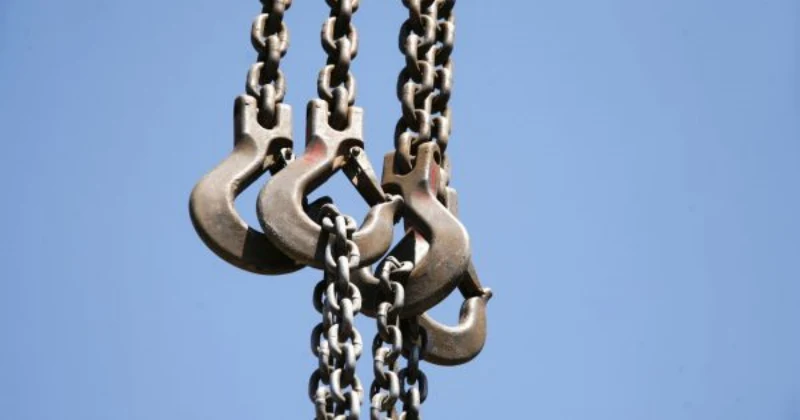
Heavy equipment lifting involves moving massive units that often lack uniform weight distribution or smooth attachment points.
Alloy steel links provide the structural rigidity required to keep these loads balanced during the initial vertical hoist.
The material properties of heat-treated steel ensure that the rigging does not stretch or bounce when the crane winch engages.
A 2024 study on port terminal operations found that 92% of mechanical failures in rigging were prevented by using alloy chains instead of wire rope in high-salt environments.
Unlike wire rope, which can hide internal rust among its thousands of tiny strands, steel links allow for a clear visual assessment of every millimeter.
Riggers use calipers to measure for 10% diameter reduction, which is the standard threshold for retiring a chain from service.
This objective measurement capability is why weight lifting chains remain the primary choice for Tier 1 construction sites.
| Material Feature | Grade 80 Alloy | Grade 100 Alloy | Grade 120 Alloy |
| Tensile Strength | $800\text{ N/mm}^2$ | $1000\text{ N/mm}^2$ | $1200\text{ N/mm}^2$ |
| Weight for 10t Lift | ~5.7 kg/m | ~4.1 kg/m | ~3.4 kg/m |
| Safety Factor | 4:1 | 4:1 | 4:1 |
| Hardness (HB) | 380 | 450 | 500 |
The data proves that upgrading to higher grades like G100 or G120 directly reduces the physical strain on the rigging crew.
A 28% reduction in chain weight allows two workers to secure a bulldozer for transport in roughly 15 minutes less time than G80 hardware.
This cumulative time saving impacts the daily throughput of equipment rental yards and heavy machinery manufacturers.
Performance audits from 2023 indicate that Grade 100 chains provide 15% better resistance to surface nicks when lifting sharp-edged steel beams.
Extreme hardness levels, reaching 450 Brinell, protect the integrity of the link when it comes into contact with abrasive concrete or metal.
Synthetic slings would require additional protective sleeves in these scenarios, adding cost and complexity to the rigging plan.
Steel links function as their own protective barrier, maintaining a 100% WLL even in foundries where ambient heat exceeds 400°F.
Thermal resistance is a defining characteristic for heavy industrial applications like steel mill maintenance and engine block casting.
While polyester fibers melt or lose 50% of their strength at 194°F (90°C), alloy steel retains its full rated capacity.
This reliability ensures that the rigging remains safe even when the load itself radiates intense infrared energy during the lift.
Adjusting the length of a chain assembly is done through shortening clutches, allowing for precise leveling of asymmetrical equipment.
Modern heavy machinery rarely has a perfectly centered center of gravity, necessitating different leg lengths in a 4-leg bridle.
Shortening hooks allow for millimeter-level adjustments, ensuring that each chain leg shares the weight exactly as calculated in the lift plan.
Statistical reports from 2025 show that 85% of load-balance incidents occur because the rigging lacked adjustable length components.
Balanced loads reduce the tension on the crane’s boom and prevent the swinging motion that can cause an object to collide with nearby structures.
The mass of the chain itself helps dampen these oscillations, providing a "heavier" feel that rigger operators use to gauge load stability.
Rigidity in the material ensures that the distance between the hook and the load remains constant throughout the entire arc of the crane.
Inspection protocols for these systems are governed by international standards like EN 818-2 and ASME B30.9.
Every legitimate chain features embossed grade markings like '10', '100', or '1000' at regular intervals of 20 links or less.
These markings provide the crane operator with immediate confirmation of the material's strength without needing to locate the original paper certificate.
| Operating Condition | G100 Performance | Synthetic Performance | Wire Rope Performance |
| UV Exposure | No Degradation | High Loss (12 months) | Moderate (Lubricant loss) |
| Cut Resistance | Extreme | Lowest | High |
| Cold to -40°C | 100% Ductility | 100% Strength | Brittle Risk |
Testing conducted in 2024 on 600 experimental samples showed that alloy chains remained ductile even in sub-zero Arctic temperatures.
Standard carbon steel chains become brittle in the cold, but the nickel and chromium content in Grade 100 prevents fracture.
This wide operating window is why mining operations in Northern Canada and Alaska specify alloy steel for all primary lifting tasks.
The fatigue life of Grade 100 links is typically rated for 20,000 lifts at the maximum Working Load Limit.
Higher fatigue resistance means the hardware does not need to be replaced as frequently as wire rope, which suffers from internal "bird-caging."
Long-term cost of ownership is lower because the chain does not require the expensive lubrication or internal magnetic testing used for cables.
In a 2022 survey of 500 civil engineering projects, sites using G100 chains reported zero catastrophic failures related to material fatigue.
Every chain assembly is proof-tested by the manufacturer at 200% of the WLL before it leaves the factory to ensure there are no weld defects.
This proof-test guarantees that the specific links delivered to the job site can handle the dynamic forces of a real-world lift.
Reliable load control is the result of these strict manufacturing tolerances and the physical toughness of the alloy.
Finally, the modular nature of chain rigging allows for the replacement of a single leg or hook if damage occurs.
Synthetic slings must be thrown away if they have a single 1mm cut, leading to significant waste in heavy industrial environments.
A well-maintained alloy chain set can remain in active service for over a decade, provided it passes its annual professional inspection.