
A refillable perfume has two cost structures, and buyers who treat it as one usually get the second one wrong. The initial pack and the refill are sourced, filled and tested separately, and their economics move independently. A framework that costs them in sequence, fixes the specification before comparing prices and treats compliance and testing as scheduled work rather than overhead will produce a number the brand can actually plan against.
Key takeaways
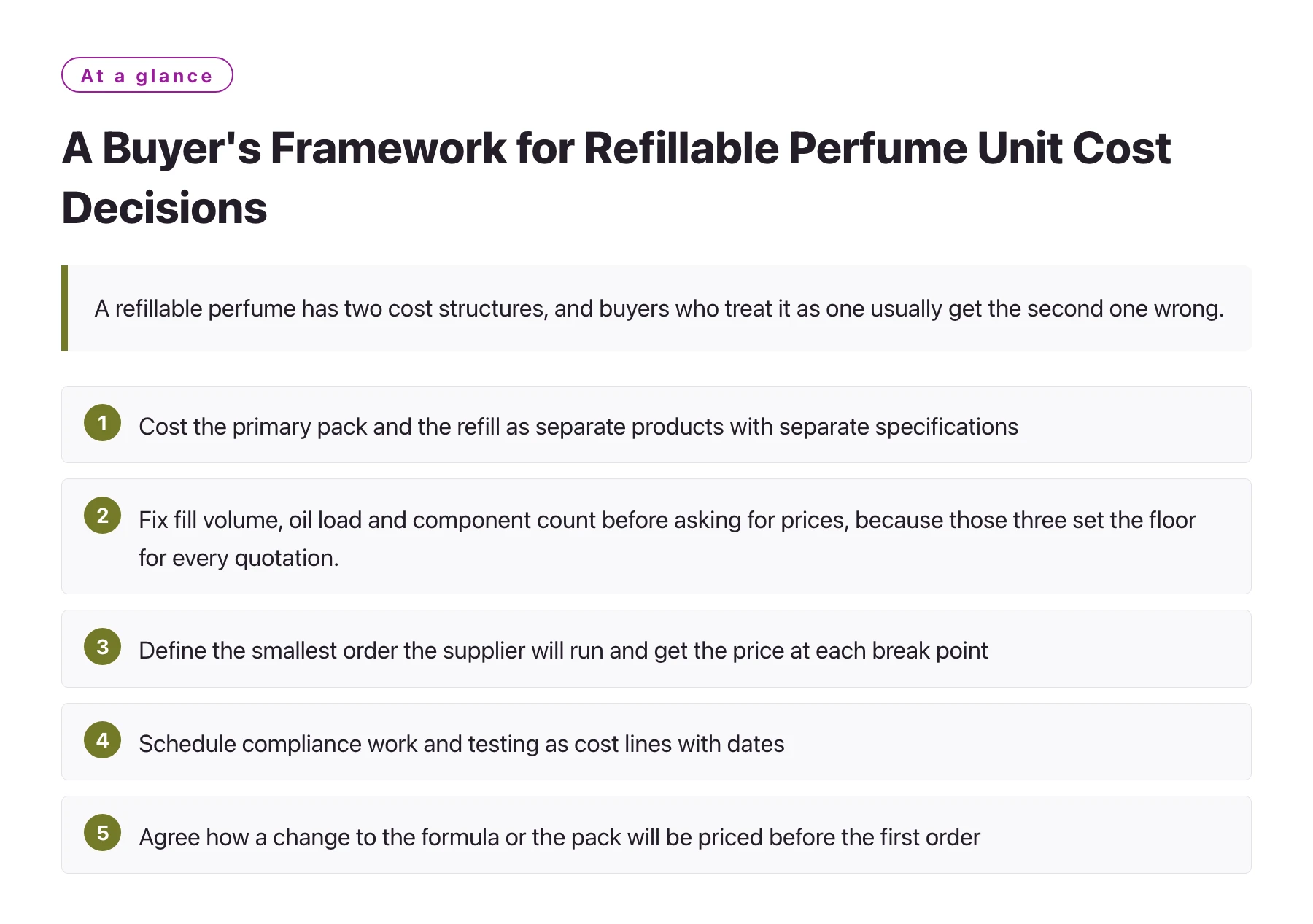
- Cost the primary pack and the refill as separate products with separate specifications, even when they are sold together.
- Fix fill volume, oil load and component count before asking for prices, because those three set the floor for every quotation.
- Define the smallest order the supplier will run and get the price at each break point, since refillable components often have different minimums.
- Schedule compliance work and testing as cost lines with dates, not as items to be resolved once the product exists.
- Agree how a change to the formula or the pack will be priced before the first order, because a change after the pilot run is the most expensive kind.
When a refillable line is being planned, the cost conversation tends to start with the bottle and end with the concentrate, leaving the refill as an assumption. The assumption is what breaks the model, because the refill is both a component purchase and a repeat product with its own minimum order and its own filling economics.
The framework below is written as a sequence. Each step is cheap to complete on paper and expensive to skip, and the order matters because a later decision cannot repair an earlier one.
The sequence, in the order the decisions bind
- Split the product into two cost objectsCost the primary pack and the refill separately, including the refill vessel, its closure and any transfer element, then decide how the two prices support each other in the market.
- Freeze the parameters that drive material costFill volume and fragrance load determine the most expensive input. Fix both, on paper, before any supplier is asked for a figure.
- Count the components and assign each specification an ownerEvery bill-of-materials line needs a specification owner. Components the brand specifies are the brand's cost risk; components the supplier specifies are the supplier's.
- Establish the smallest viable run and the break pointsAsk for the price at the smallest run and at the next two steps up. Refill components can have their own minimums, so the two products may not share a break point.
- Put compliance and testing on the calendar with a costStability, compatibility and documentation work have durations. Scheduling them as project lines prevents them being discovered as delays.
- Write the change ruleAgree in advance what happens to price and schedule if the formula or the pack changes after approval, and who pays for each kind of change.
The decisions that feel like savings and are not
Removing the refill from the first order
It is tempting to launch the pack first and add refills later, on the reasoning that the format is proven by the primary product. In practice the refill is where the technical difficulty sits: the seal, the transfer and the compatibility between the refill container and the concentrate. Delaying it moves that work into a second project and usually costs more than doing it once, with a second qualification round and a second artwork cycle.
There is a regulatory argument as well. Rules on packaging and packaging waste are increasingly written around reuse and refill design rather than around the primary pack alone, so a format that markets itself as refillable without a durable refill poses a compliance question, not only an operational one [1].
Trimming the fragrance load to reach a price
Reducing the oil load is the fastest legitimate way to lower unit cost, and the fastest way to lose the product. The decisive question is whether the change is detectable in use, which is a testing question rather than a spreadsheet one. A lower load that still performs is a real saving; a lower load that shortens wear converts a cost decision into a returns problem.
Restrictions on how much of a given material may be used, and in which product categories, set a hard ceiling on what can be adjusted [2]. Any change to the load should therefore be checked against the material limits for the format, not only against the brand's target price.
Treating documentation as paperwork
A cosmetic product needs documentation for the market it is sold in, and the obligations sit with the brand even when the work is delegated to a supplier. Cosmetic claims are also expected to be substantiated and not misleading, which puts the wording on the pack inside the same regulated space as the product itself [3]. A brand that plans the documentation before sampling pays for it once; one that plans it afterwards pays in artwork revisions and lost launch weeks.
Using the framework when two quotes disagree
Once the six steps are complete, a large gap between two quotations usually localises itself to a step: one supplier has priced the refill with a qualified component, the other has assumed a generic one. Comparing the answers step by step, rather than the totals, is what makes that visible.
It also helps to see the full scope on one page, because scope defines the steps. This is where a manufacturer page earns its place in the process: this Chinese perfume manufacturer sets out development, filling and pack sourcing together, and a scope list like that is a useful template for step three.
Working with a perfume production partner in China compresses the component supply chain, because bottle, closure and carton sourcing sit closer to filling, but it also concentrates risk: if one qualification slips, everything behind it moves. Portfolio material on the brands Xuelei has manufactured for answers a different question, about breadth rather than about price, and should be read that way.
Complete the six steps on one page before requesting prices. A supplier can only quote what the brand has decided, and an undecided step always comes back as a higher figure or an exclusion.
Sources
- European Commission: Packaging Waste and the PPWR —— EU rules on packaging and packaging waste, including the Packaging and Packaging Waste Regulation requirements on recyclability and design.
- IFRA: Safe Use and Fragrance Science —— IFRA's explanation of how fragrance materials are scientifically assessed for safe use and how those conclusions are applied by the industry.
- European Commission: Cosmetic Products — Specific Topics —— EU pages covering specific cosmetics topics such as product claims, nanomaterials and animal-testing rules.
Frequently asked questions
Should a refill be priced the same as the primary pack?
No. They have different component counts and often different order quantities. Price them separately, then check that the pair supports the retail price you intend to charge.
What is the biggest cost driver in a refillable perfume?
The fragrance compound, because it is the most expensive input and the fill volume multiplies it. Component complexity and decoration add the rest.
Can compliance work be left to the supplier?
The work can be delegated, but the responsibility for placing a compliant product on the market stays with the brand. Confirm in writing which documents the supplier provides and which the brand must prepare.
How many quotes are enough to make a decision?
Two comparable quotes built on the same specification are more useful than five built on different assumptions. Comparability matters more than the number.
When should a brand revisit unit cost?
At every specification change and at every quantity change. Outside those moments the figure should be stable, and if it is not, the assumptions behind it were not written down.