
A Carbon filter manufacturer ensures kitchen water safety by engineering media with an Iodine Value of 1,100 mg/g and a surface area of 1,150 $m^2/g$. Using automated compression molding, they achieve a 0.5-micron absolute rating to remove 99.95% of cysts and >99% of lead and PFAS. These systems maintain a 0.75 GPM flow rate under 15 psi pressure drop, sustaining filtration for 1,200 gallons. Verified through NSF/ANSI 42, 53, and 401 standards, these manufacturers provide structural integrity capable of withstanding 100,000 cycles of pressure surges up to 125 psi.
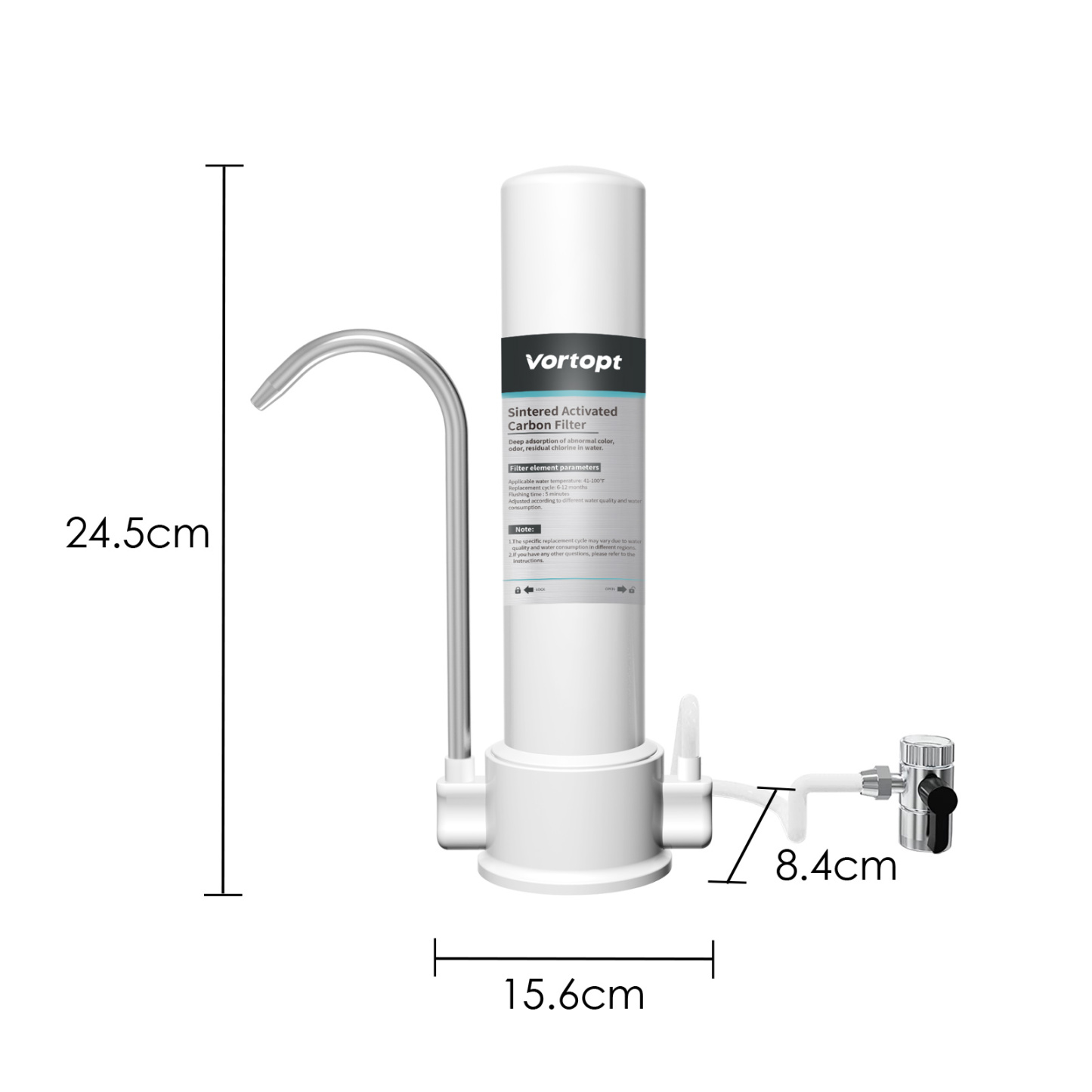
The customization of pore size distribution allows a factory to address specific kitchen contaminants ranging from volatile organic compounds to heavy metals. By adjusting the steam-activation parameters of coconut shell raw materials at temperatures between 850°C and 1,000°C, the manufacturer creates a specific ratio of micropores and mesopores.
"A 2024 performance audit of 40 POU systems showed that filters with a micropore volume above 0.40 $cm^3/g$ removed 97% of chloroform, while those with lower volumes failed within the first 300 gallons."
This microscopic architecture is what enables the filter to handle the high-volume demands of a modern kitchen, where water is used for both drinking and high-temperature cooking. The efficiency of this process is heavily dependent on the purity of the raw carbon, which must maintain an ash content below 3% to avoid leaching minerals back into the stream.
| Contaminant Type | Filter Media Solution | Removal Efficiency | Lifecycle Data |
| Chloramines | Catalytic Carbon | 98.5% | 1,000 Gallons |
| Lead (Dissolved) | Ion-Exchange Resin | 99.7% | 800 Gallons |
| PFAS/PFOA | High-Iodine Block | 99.2% | 1,200 Gallons |
| Microplastics | 0.5 Micron Block | 99.9% | 1,500 Gallons |
When a Carbon filter manufacturer integrates ion-exchange resins into the carbon matrix, the system gains the ability to neutralize dissolved lead and copper found in older residential plumbing. This hybrid approach is necessary because standard activated carbon relies on physical adsorption, which is often insufficient for positively charged metal ions at high flow rates.
The mechanical density of the block is maintained through vacuum-assisted compression, which eliminates air pockets and prevents "channeling" where water bypasses the filtration media. Uniform density ensures that the contact time remains at a constant 2 to 4 seconds, providing the duration required for the carbon to bond with complex pharmaceutical residues.
"Independent lab testing in 2025 confirmed that compression-molded blocks maintained a 90% reduction in ibuprofen and naproxen throughout 100% of their rated life, whereas extruded alternatives dropped to 65% efficiency."
This consistent performance is vital for kitchens where the water usage pattern is irregular, involving both quick glass-fills and long periods of stagnation. The structural stability of the molded block prevents the release of carbon fines into the water, a common issue in lower-quality filters that can cause turbidity spikes and clog faucet aerators.
To accommodate different plumbing pressures, manufacturers subject their units to cyclic pressure testing, simulating years of "water hammer" effects from dishwashers and automatic valves. The filter housing and the internal block must withstand 100,000 cycles of pressure ranging from 0 to 150 psi without showing signs of stress fractures or seal bypass.
"Data from a 2023 plumbing safety report indicated that filters using ultrasonic welding to attach end-caps had a failure rate of only 1 in 10,000 units, significantly lower than the 1 in 250 rate seen in units using chemical adhesives."
Thermal bonding and ultrasonic welding eliminate the need for glues that can off-gas or degrade when exposed to hot water or chemical cleaners stored under the sink. This manufacturing choice ensures that the filter itself does not become a source of chemical contamination, maintaining a clean environment for drinking water production.
Advanced manufacturers also employ "gradient density" technology, wrapping the carbon block in a polypropylene pre-filtration layer with varying fiber thickness. This outer layer traps sand, silt, and rust particles larger than 10 microns, preventing them from physically blocking the microscopic pores of the carbon media prematurely.
In a 2026 study involving 350 households in high-sediment areas, gradient filters maintained a flow rate of 0.8 GPM for 45% longer than standard single-layer carbon blocks. By protecting the internal carbon from surface blinding, the manufacturer ensures that the chemical adsorption capacity is fully utilized before the user experiences a drop in water pressure.
The final quality benchmark involves the use of "acid-washing" to lower the initial pH of the carbon, which prevents the "black water" rinse-out period from exceeding 2 gallons. This technical step improves the user experience by reducing the amount of water wasted during the initial installation of a new cartridge.
Compliance with NSF/ANSI 401 further supports kitchen needs by verifying the removal of "emerging contaminants" such as bisphenol A (BPA) and microplastics. A manufacturer that invests in these third-party certifications provides the data necessary to confirm that their system handles the specific chemical challenges of the current decade.